- You feel it within days. The stretch gets easier in the first week, because your nervous system quickly learns to let you go deeper [1].
- You can measure it in three to six weeks. In trials of that length, adults with tight hamstrings got 4 to 10 cm closer to the floor and gained 9 to 11 degrees at the knee [2][3][4].
- Twelve weeks changes how you move. In a 12-week trial of 173 students, the average gain was 15 degrees of straight-leg raise [5].
- Age does not hold you back. A pooled analysis of 77 studies found no significant link between age and range gained [6]. After 65, 60-second holds gained range fastest [7].
- Gentle and often wins. Three sessions a week beat one [2], and gentle stretching gained as much range as stretching into strong discomfort [8].
- The habit keeps it. In one study, six weeks of gains had faded four weeks after people stopped [4]. A couple of minutes on most days is the whole plan.
- FlexBuddy® makes those minutes count. It keeps your back straight so the stretch lands in your hamstrings and calves, and its strap lets you count your progress loop by loop.
What flexibility is, and why it comes back quickly
Flexibility is the range through which a joint can move: how far the hip folds, how far the knee straightens. It is specific to each joint. You can have loose shoulders and hamstrings like steel cable, so a timeline is always about one movement at a time. Most of the research, and most of this article, is about the hamstrings, the three muscles on the back of the thigh that run from the sitting bone to just below the knee.
Two things set the limit of a stretch. One is mechanical: the stiffness and length of the muscle and its tendon. The other is sensory: the point at which your nervous system reads the pull as too much and makes you stop. A widely cited review in the journal Physical Therapy concluded that the gains seen after a single session, and after programmes of three to eight weeks, are mostly explained by a change in sensation. People tolerate a deeper stretch before the alarm goes off [1].
That is why progress starts so soon. Your nervous system only has to learn that the position is safe, and it learns fast.
What changes in days, weeks and months
Days: the stretch starts to feel good
In the first week, the position you could barely hold on Monday feels ordinary by Friday. You reach further straight after every session, while the stretched tissue is still a little longer. What carries over from day to day is tolerance [1]. This is your first win, and you will notice it before the week is out.
Weeks: range you can measure
Between week three and week six, the change shows up on a tape measure. A clinical review of the stretching literature concludes that six to eight weeks of static stretching is enough to increase hamstring length, and notes that people with chronic musculoskeletal pain tolerated more stretch after only three weeks [9].
Months: the range becomes yours
Keep going and it keeps coming. In a 12-week trial of untrained men who stretched their hamstrings, range was up 13.4% at six weeks and 14.6% at twelve [8]. By then the routine no longer needs willpower. It is simply part of your day.
What the trials gained in 4, 6, 8 and 12 weeks
Here is what real stretching programmes produced, in the units each study used. Almost all used static holds, meaning a position held still, on the hamstrings.
| Length | Who | Programme | Gain |
|---|---|---|---|
| 4 weeks | Healthy adults with tight hamstrings | Two 30-second holds per exercise, once, three or five times a week | Fingertips closer to the floor by 4 cm (once a week), 10 cm (three times), 7.5 cm (five times) [2] |
| 4 weeks | Healthy adults aged 18 to 46 | Daily or three days a week, once or twice a day | Hip range up 16.8% with three sessions a week, 24% with six or more [10] |
| 6 weeks | Adults aged 21 to 41 with tight hamstrings | One 30-second hold, five days a week | Knee extension up 11.4 degrees; 0.7 in the group that did not stretch [3] |
| 6 weeks | Inactive students, average age 21 | Two 30-second holds a day, five days a week | Knee range up from 143 to 152 degrees [4] |
| 8 weeks | Women in a nursing home, average age 67 | Four one-minute stretches, three times a week | Hamstring flexibility up 30%, from 59.5 to 76.5 degrees [11] |
| 12 weeks | 173 recreationally active students | 180 seconds a day, three days a week | Straight-leg raise up 15.1 degrees on average; no change in the control group [5] |
| 12 weeks | Untrained men | Low-intensity or high-intensity holds | Range up 13.4% at six weeks, 14.6% at twelve [8] |
Three things stand out. Every group that stretched improved, even the one that stretched once a week. The gains are big enough to see and feel: ten or fifteen degrees, or several centimetres closer to the floor. And they come early: in the trial that measured at both six and twelve weeks, most of the improvement had arrived by week six [8].
Now look at the programme column. One 30-second hold a day, five days a week, added 11.4 degrees in six weeks [3]. A small commitment, kept.
Older adults: the same gains, with longer holds
The most encouraging trial of all had an average age of 84.7. People with tight hamstrings stretched five times a week for six weeks with holds of 15, 30 or 60 seconds. The 60-second group gained 2.4 degrees a week, against 1.3 for 30 seconds and 0.6 for 15 [7]. If it works at that age, it works at yours. In younger adults, 30 seconds worked as well as 60 [12], and once a day did as much as three times a day [13]. That is why advice for older adults leans towards longer holds than the usual 15 to 30 seconds [9]. The reasoning is in how long to hold a stretch, and the age-specific routine is in flexibility after 50.
Do you lose flexibility if you stop? How to keep it
Keep stretching and you keep your range. Stop completely and it fades within weeks, which is why a small daily habit beats a big project. In the study of inactive students, six weeks of stretching took knee range from 143 to 152 degrees. After four weeks without stretching it was back to 145. Then they started again, and six more weeks took them to 154 degrees [4]. It comes back when you do.
Other studies are kinder still. In a four-week programme, every stretching group kept a significant part of its gain after four weeks off [10]. In the trial of older adults, the 60-second group still had 5.4 degrees of extra range four weeks after the programme ended [7]. Calves follow the same rule as hamstrings: in men who stretched them for five weeks, ankle range was back at its starting point five weeks after they stopped [14].
So the answer is a maintenance dose, and it is tiny. The American College of Sports Medicine recommends flexibility exercises on at least two days a week to maintain joint range of movement [15]. Two minutes on most days covers that with room to spare. Keep FlexBuddy where you will see it, by the sofa or beside the bed, and the habit looks after itself.
What sets the pace: age, starting point, frequency, consistency and pain
Age
Age gets blamed for too much. A national US survey of hip and knee movement in 1,683 adults found that, for most movements, the oldest group had only 3 to 5 degrees less range than the youngest. The authors concluded that, at least up to age 74, any substantial loss of joint mobility should be treated as abnormal and not put down to ageing [16]. Stiffness is not a birthday present. And it trains just as well later in life: a 2024 meta-analysis of 77 stretching studies found no significant relationship between age and how much range people gained [6].
So at 40 or 50, the timeline in this article is yours as written. Past 65, use longer holds.
Starting point
Your starting point sets the distance, and every week moves you along it. Stylianos T., a FlexBuddy owner, measured his progress: "I can now bend 15 cm more than before in the space of 6 months." Measure where you are before you begin, with the hamstring flexibility test, so that every centimetre you gain shows up.
Frequency
Frequency is the lever with the most evidence behind it. Over four weeks, stretching three times a week brought people 10 cm closer to the floor, against 4 cm for once a week [2]. In another four-week trial, people who fitted in six or more sessions a week gained more again: 24% against 16.8% for three [10]. A review of 23 long-term studies linked weekly frequency to range and recommended at least five days and at least five minutes of stretching a week [17]. So three days a week works, and most days is the surest bet. There is more in how often you should stretch.
Consistency
A short routine done most days takes you further than an ambitious one you drop in February, because range fades when the stretching stops [4]. Two minutes is short enough to do on your worst day.
Pain
You do not have to suffer for it. In the 12-week intensity trial, men who stretched gently gained as much range as men who stretched to a high level of discomfort [8]. Stretch to a clear pull that you can breathe through.
A realistic timeline: milestones from week 1 to week 12
This table is for a stiff but healthy adult who stretches the hamstrings for a couple of minutes on at least five days a week. It is built from the trials above. Your dates will be your own.
| When | What to expect | What to do |
|---|---|---|
| Week 1 | The stretch already feels easier. You reach further straight after every session [1]. | Learn the straight-back position. Measure your baseline and write it down. |
| Week 2 | The same position feels calm. Your body has stopped fighting it. | Keep the range the same. Add nothing except regularity. |
| Week 4 | The first change you can measure. In a four-week trial, adults with tight hamstrings got 4 to 10 cm closer to the floor [2]. | Retest under the same conditions. Shorten the FlexBuddy strap by one small step. |
| Week 8 | Larger, steadier gains: six-week trials report 9 to 11 degrees at the knee [3][4]. Your toes are coming into reach. | Hold the frequency. Add strength work through full range. |
| Week 12 | The big early gains are in. One 12-week trial averaged 15 degrees of straight-leg raise [5]. | Retest. Move to maintenance on at least two to three days a week [15][18], or set the next goal. |
How to get flexible faster: four things that work
Four things make every session count.
Stretch more often, not longer
The dose is small: about 60 seconds in total per stretch, for example three holds of 20 seconds, on at least two to three days a week [15][18]. For adults under 65, 30 seconds did as much as a full minute [12]. So if you have motivation to spare, spend it on extra days, not longer holds.
Stretch when you are warm
The American College of Sports Medicine's advice, as summarised in a clinical review, is that static stretching should follow an active warm-up [9]. In practice: after a walk or at the end of a workout.
Keep your spine straight
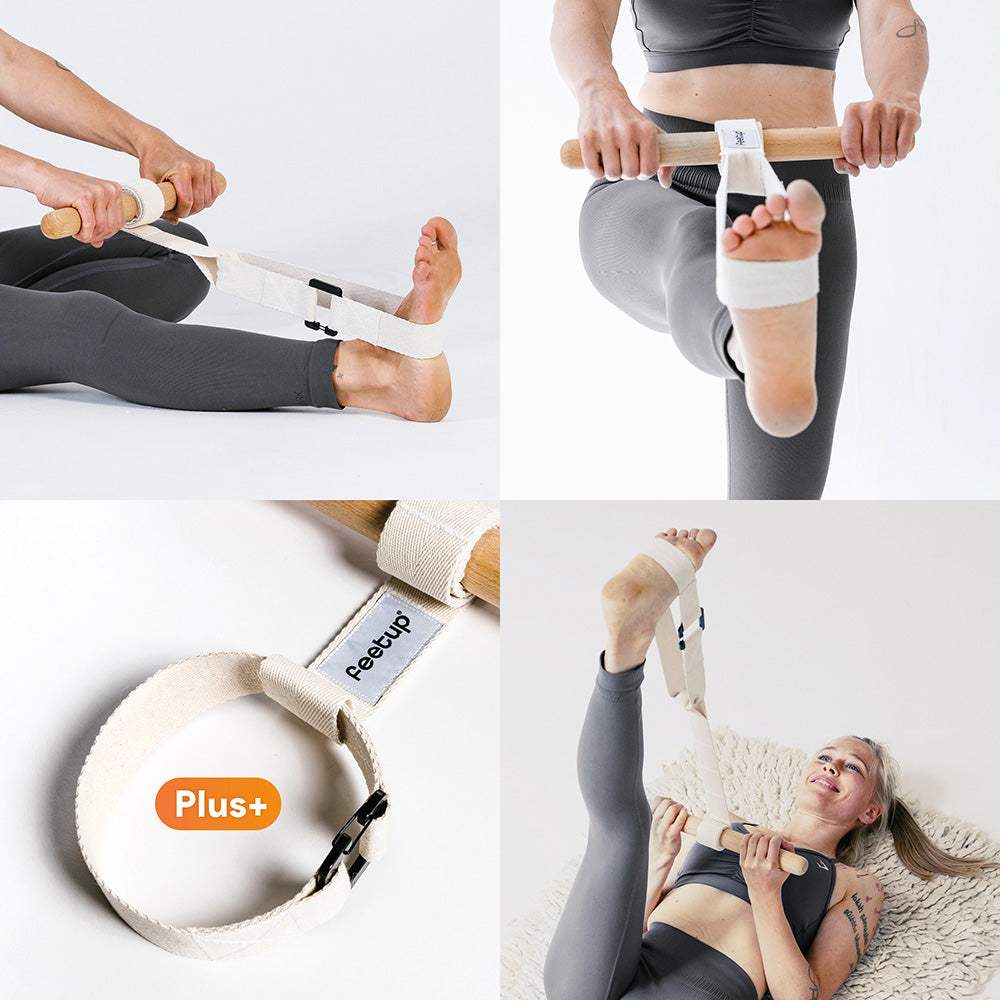
A forward bend with a rounded back gets your hands lower, but the extra distance comes from the spine and the hamstrings miss out. Sit tall, tip the pelvis forward and fold at the hip crease, and the stretch lands in the back of the thigh. This is exactly what FlexBuddy is made for. The foot bar sits under your soles, the other bar sits in your hands, and the strap between them keeps your chest up while your hands cannot reach your feet yet. A strap or towel is the simpler version. The technique is laid out in how to touch your toes.
Add strength through full range
A meta-analysis of 11 randomised trials found that strength training improved range of motion as much as stretching did [19]. Exercises that load a muscle at its longest position, such as Romanian deadlifts for the hamstrings, do double duty: they also make you stronger in the range you are gaining.
What to skip
Bouncing: static holds gained more range than ballistic stretching in two reviews of long-term programmes [17][6]. Pain: gentle stretching gains as much. And marathon holds: under 65, 30 seconds once a day is enough [13], and after 65 a minute is the sweet spot [7].
When slow progress is not a flexibility problem
A few things are not tight muscles, and they need a professional before a routine. See a doctor or physiotherapist first if the pull is sharp, if it runs down the leg as burning, tingling or numbness, if it followed a fall or a sudden pain during sport, or if it comes with weakness, fever or changes in bladder or bowel control. Do the same if you have stretched carefully for twelve weeks and measured no change at all.

Get there sooner with FlexBuddy
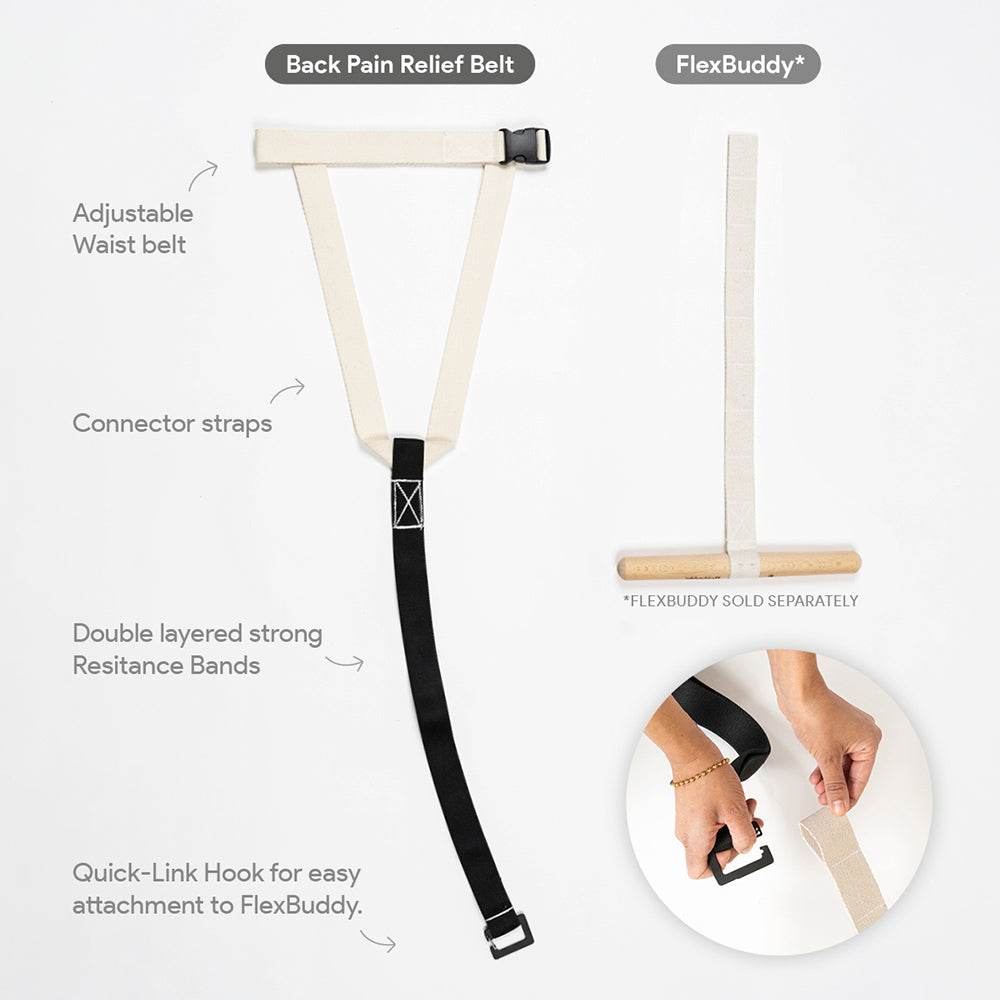
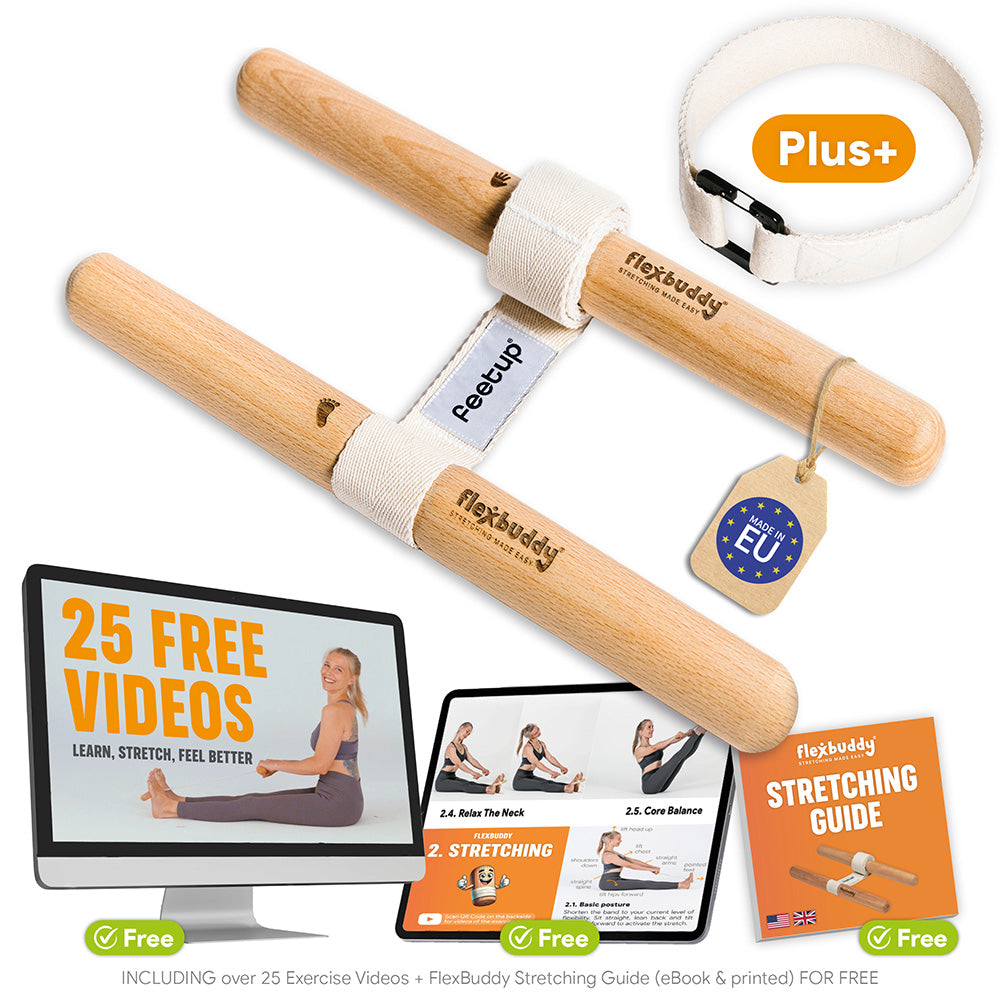
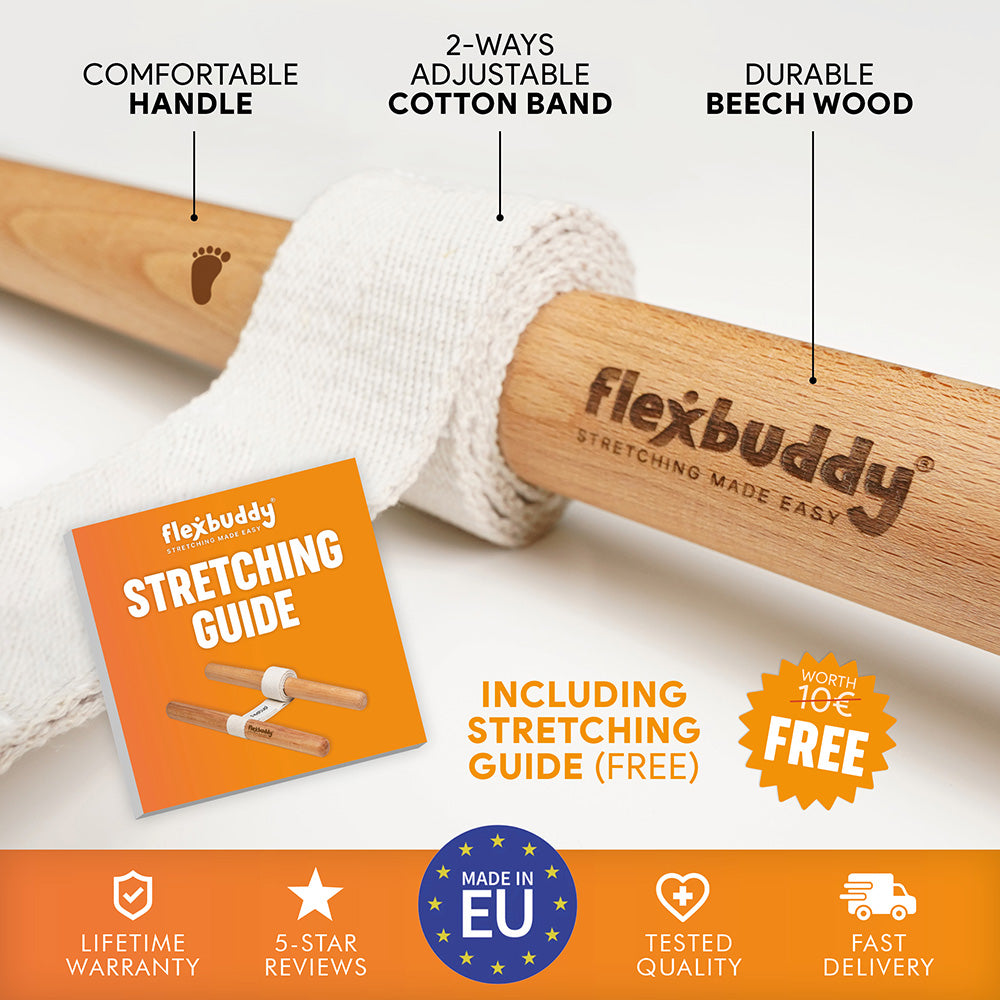
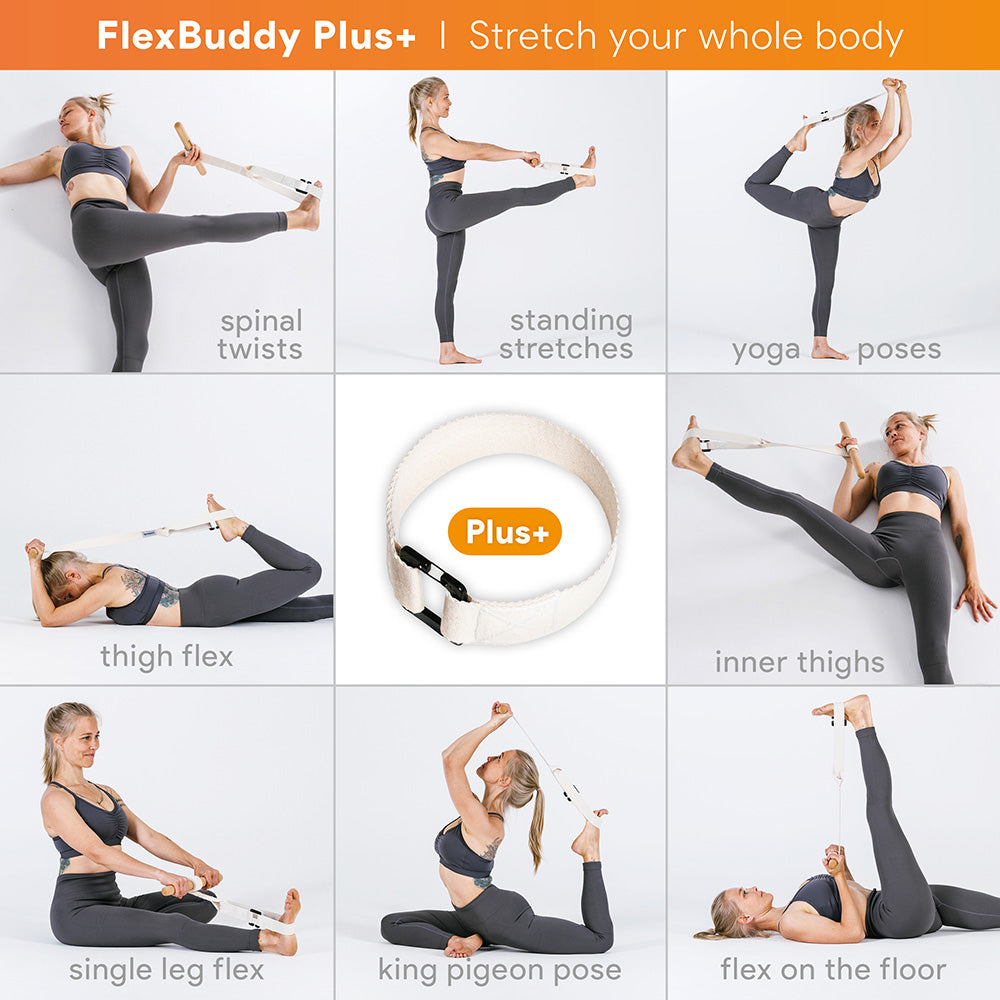
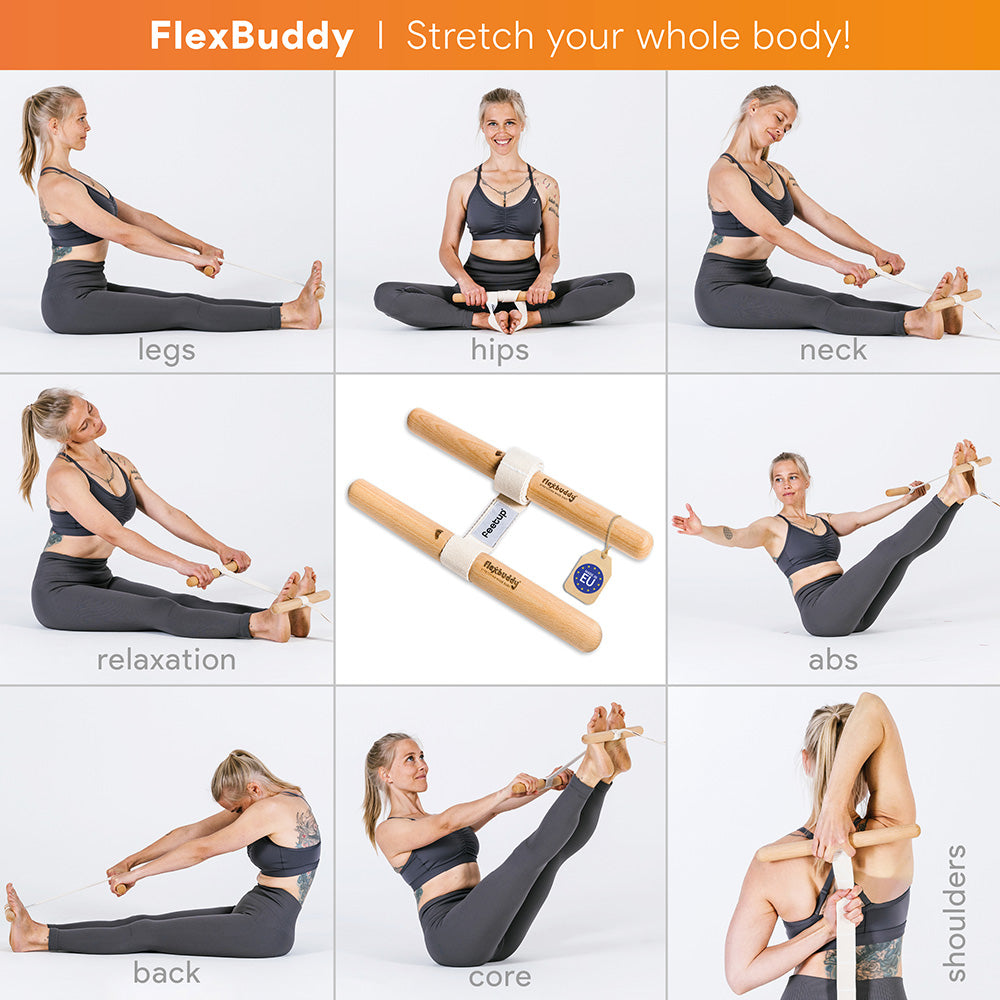
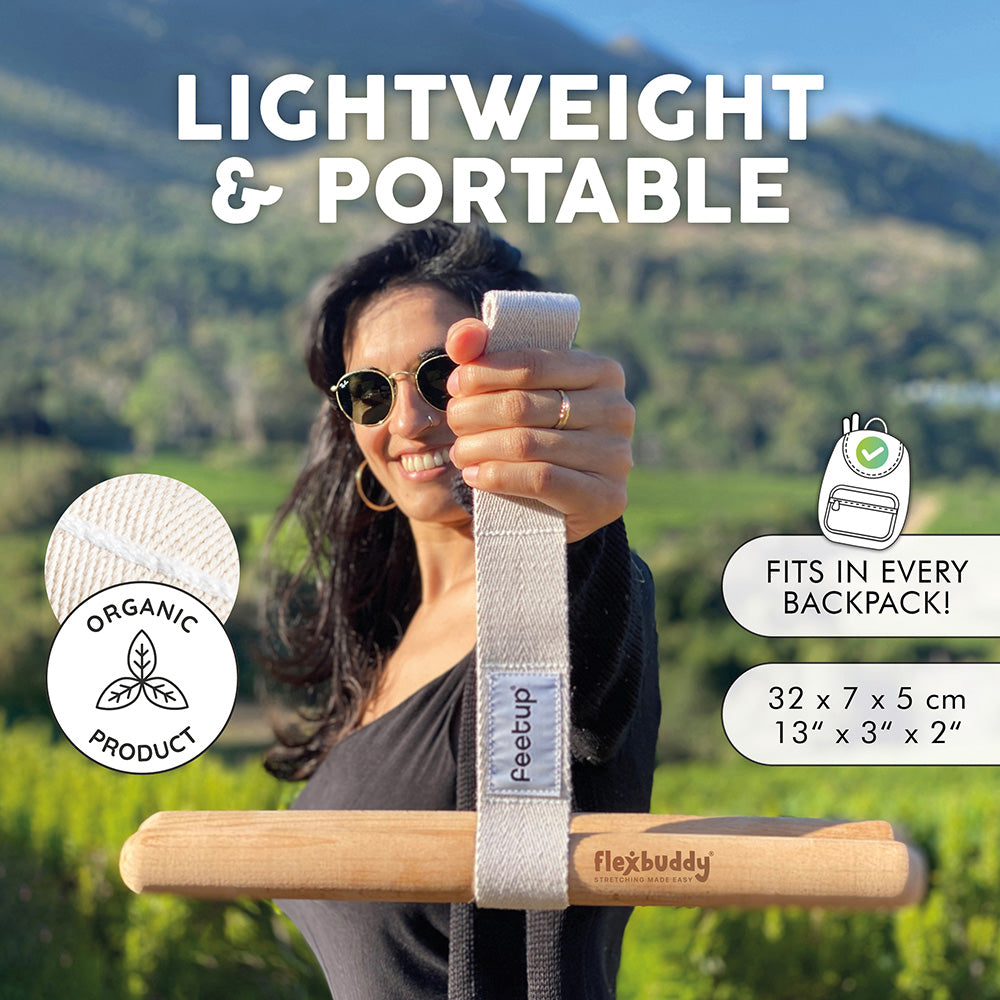
Every timeline here rests on two things: a straight back, so the stretch reaches your hamstrings, and a routine short enough to do daily. FlexBuddy® gives you both. It is a patented stretching device made of two beech-wood bars joined by an adjustable cotton strap. One bar sits under your feet, the other in your hands. You sit tall, tip the hips forward, and the strap carries the pull while your hamstrings and calves let go together. Comfortable wooden handles, no rope burn, one size for every body.
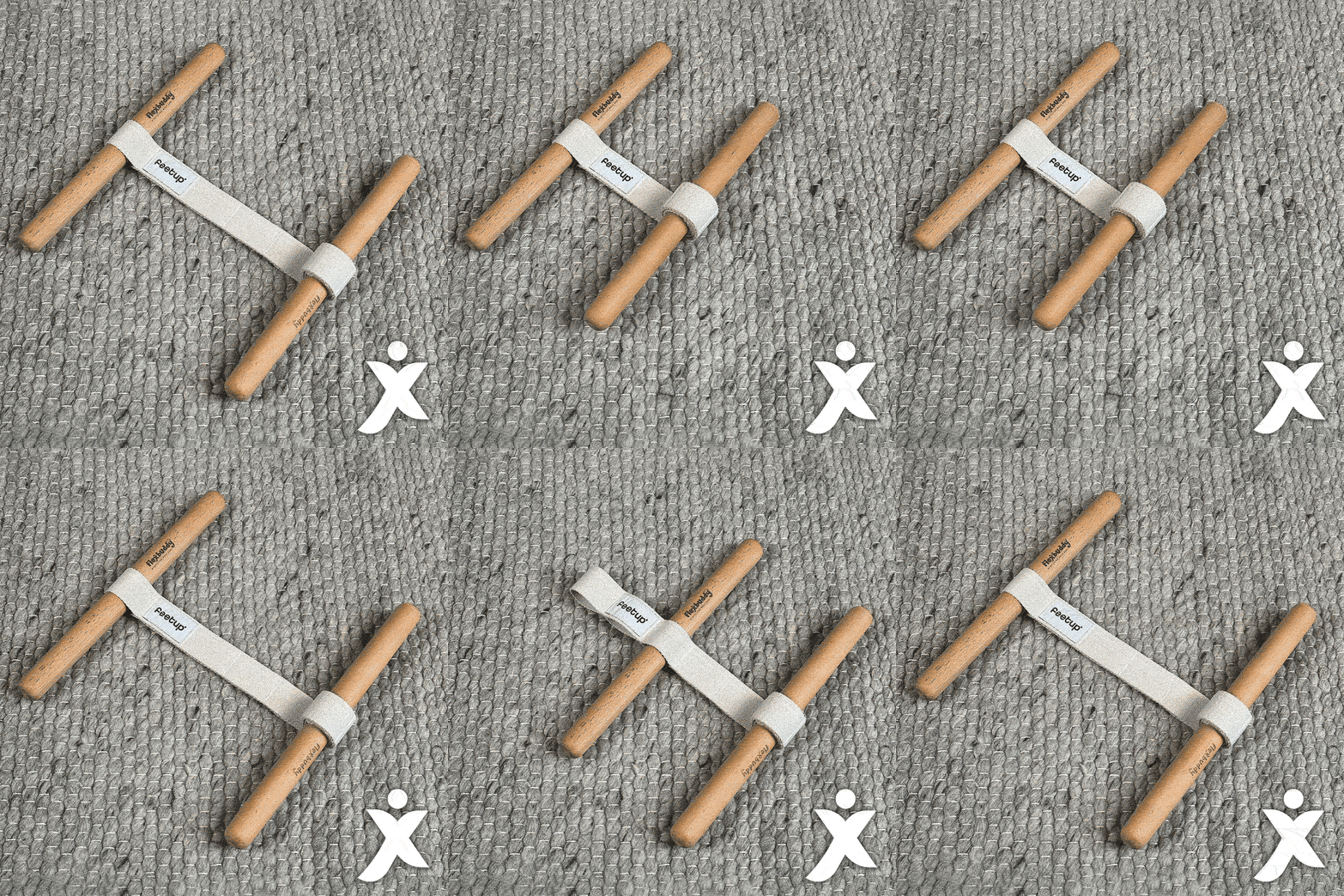
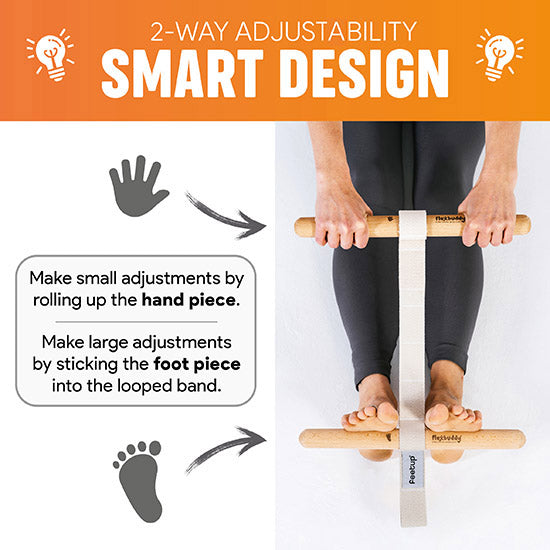
It also turns progress into something you can count. Move the foot bar to another loop for a big step, or roll the strap around the hand bar for a small one, and you see this week beat last week. The routine is ten deep breaths, three times: about two minutes a day. Bob J. wrote: "I am 64 and have never touched my toes. FlexBuddy changed that in a week!" FlexBuddy's own promise is "Flexible in 30 days". It is rated 4.5 by verified buyers and comes with a 30-day money-back guarantee and a lifetime warranty, so you can try it without risk. Get your FlexBuddy, or take the two-minute quiz to find the routine for your starting point.
Frequently asked questions
How long does it take to become flexible?
Less time than most people expect. For a stiff but healthy adult who stretches most days, the stretch feels easier within days, you can measure a change in three to six weeks, and a goal like touching your toes often arrives within two to three months. In trials, four to six weeks of hamstring stretching gained several centimetres on a toe-touch test or around 10 degrees at the knee [2][3].
Can you become flexible in a week?
You will feel the difference in a week, and you will reach further. That first change is your nervous system letting you go deeper [1]. If you are already close to your toes, seven days can be enough to get there. If you start further away, the week is your first step, and gentle stretching gets you there as fast as forcing it [8].
How long does it take to see results from stretching?
The stretch feels easier in the first week or two, and most trials measure clear results after four to six weeks [2][4]. To see your own, repeat the same test once a week and write the number down.
How long does it take to get flexible at 40 or over 50?
About the same as at 25. A meta-analysis of 77 studies found no significant link between age and how much range people gained from stretching [6]. After 65, holds of 60 seconds gained range fastest in one trial [7]. You may start further from your toes, and you close the gap at the same pace.
Do you lose flexibility if you stop stretching?
Only if you stop completely, and it takes very little to keep it. In one study, the range gained in six weeks had faded four weeks after stopping [4]; in others, part of the gain survived a month off [10][7]. Stretching on at least two to three days a week keeps what you have [15][18], and two minutes a day does it easily.
Why do I stretch every day but I'm not flexible?
Usually for one of four small reasons, and each is easy to fix. You round your back, so the stretch misses the muscle: FlexBuddy keeps your spine straight so it lands in the hamstrings. You push into pain, which gains nothing extra [8]. You have not given it four weeks yet. Or you are not measuring, so your gains go unnoticed.
This article is general information, not medical advice. Tight muscles usually respond well to regular stretching. If your pain is sharp, radiates down a leg, comes with numbness, weakness, fever, bladder or bowel changes, follows an injury, or keeps getting worse, see a doctor or physiotherapist before you stretch.
References
- Weppler CH, Magnusson SP. Increasing muscle extensibility: a matter of increasing length or modifying sensation? Phys Ther. 2010;90(3):438–449. doi:10.2522/ptj.20090012. PMID 20075147.
- Marques AP, Vasconcelos AA, Cabral CM, Sacco IC. Effect of frequency of static stretching on flexibility, hamstring tightness and electromyographic activity. Braz J Med Biol Res. 2009;42(10):949–953. doi:10.1590/S0100-879X2009001000012. PMID 19784479.
- Bandy WD, Irion JM, Briggler M. The effect of static stretch and dynamic range of motion training on the flexibility of the hamstring muscles. J Orthop Sports Phys Ther. 1998;27(4):295–300. doi:10.2519/jospt.1998.27.4.295. PMID 9549713.
- Willy RW, Kyle BA, Moore SA, Chleboun GS. Effect of cessation and resumption of static hamstring muscle stretching on joint range of motion. J Orthop Sports Phys Ther. 2001;31(3):138–144. doi:10.2519/jospt.2001.31.3.138. PMID 11297019.
- Sainz de Baranda P, Ayala F. Chronic flexibility improvement after 12 week of stretching program utilizing the ACSM recommendations: hamstring flexibility. Int J Sports Med. 2010;31(6):389–396. doi:10.1055/s-0030-1249082. PMID 20309785.
- Konrad A, Alizadeh S, Daneshjoo A, et al. Chronic effects of stretching on range of motion with consideration of potential moderating variables: a systematic review with meta-analysis. J Sport Health Sci. 2024;13(2):186–194. doi:10.1016/j.jshs.2023.06.002. PMID 37301370.
- Feland JB, Myrer JW, Schulthies SS, Fellingham GW, Measom GW. The effect of duration of stretching of the hamstring muscle group for increasing range of motion in people aged 65 years or older. Phys Ther. 2001;81(5):1110–1117. PMID 11319936. https://pubmed.ncbi.nlm.nih.gov/11319936/ (accessed 4 Nov 2026).
- Beltrão NB, Ximenes Santos C, de Oliveira VMA, et al. Effects of a 12-week chronic stretch training program at different intensities on joint and muscle mechanical responses: a randomized clinical trial. J Sport Rehabil. 2020;29(7):904–912. doi:10.1123/jsr.2018-0443. PMID 31648203.
- Page P. Current concepts in muscle stretching for exercise and rehabilitation. Int J Sports Phys Ther. 2012;7(1):109–119. PMC3273886. https://pmc.ncbi.nlm.nih.gov/articles/PMC3273886/ (accessed 4 Nov 2026).
- Cipriani DJ, Terry ME, Haines MA, Tabibnia AP, Lyssanova O. Effect of stretch frequency and sex on the rate of gain and rate of loss in muscle flexibility during a hamstring-stretching program: a randomized single-blind longitudinal study. J Strength Cond Res. 2012;26(8):2119–2129. doi:10.1519/JSC.0b013e31823b862a. PMID 22027850.
- Gallon D, Rodacki AL, Hernandez SG, et al. The effects of stretching on the flexibility, muscle performance and functionality of institutionalized older women. Braz J Med Biol Res. 2011;44(3):229–235. doi:10.1590/S0100-879X2011007500012. PMID 21399855.
- Bandy WD, Irion JM. The effect of time on static stretch on the flexibility of the hamstring muscles. Phys Ther. 1994;74(9):845–850. doi:10.1093/ptj/74.9.845. PMID 8066111.
- Bandy WD, Irion JM, Briggler M. The effect of time and frequency of static stretching on flexibility of the hamstring muscles. Phys Ther. 1997;77(10):1090–1096. doi:10.1093/ptj/77.10.1090. PMID 9327823.
- Nakamura M, Yahata K, Sato S, et al. Training and detraining effects following a static stretching program on medial gastrocnemius passive properties. Front Physiol. 2021;12:656579. doi:10.3389/fphys.2021.656579. PMID 33868026.
- Garber CE, Blissmer B, Deschenes MR, et al.; American College of Sports Medicine. Position stand: quantity and quality of exercise for developing and maintaining cardiorespiratory, musculoskeletal, and neuromotor fitness in apparently healthy adults. Med Sci Sports Exerc. 2011;43(7):1334–1359. doi:10.1249/MSS.0b013e318213fefb. PMID 21694556.
- Roach KE, Miles TP. Normal hip and knee active range of motion: the relationship to age. Phys Ther. 1991;71(9):656–665. doi:10.1093/ptj/71.9.656. PMID 1881956.
- Thomas E, Bianco A, Paoli A, Palma A. The relation between stretching typology and stretching duration: the effects on range of motion. Int J Sports Med. 2018;39(4):243–254. doi:10.1055/s-0044-101146. PMID 29506306.
- Harvard Health Publishing. The ideal stretching routine. Harvard Medical School, 16 Mar 2026 (reviewed by H. E. LeWine, MD). https://www.health.harvard.edu/staying-healthy/the-ideal-stretching-routine (accessed 4 Nov 2026).
- Afonso J, Ramirez-Campillo R, Moscão J, et al. Strength training versus stretching for improving range of motion: a systematic review and meta-analysis. Healthcare (Basel). 2021;9(4):427. doi:10.3390/healthcare9040427. PMID 33917036.